

African Union warns about the continued remnants of the Moroccan occupation.
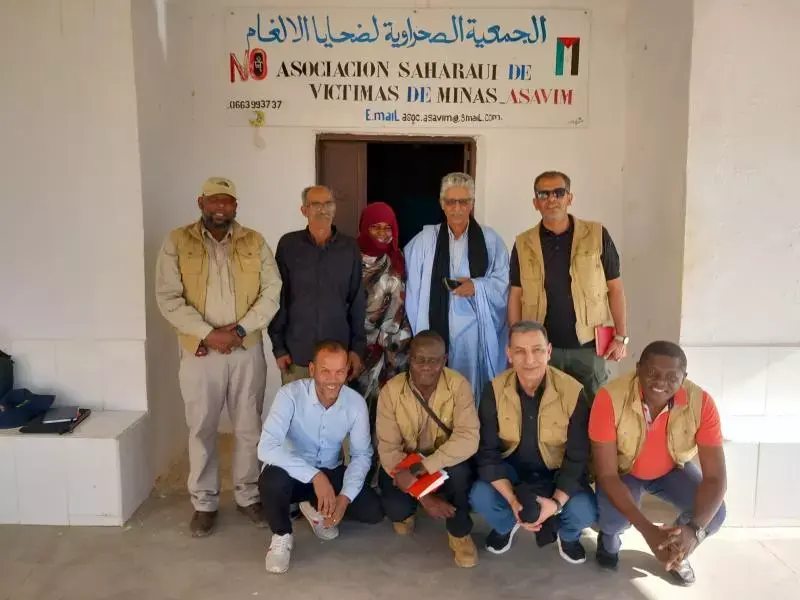
An African Union delegation specializing in landmine action visited Sahrawi refugee camps this week, where members met survivors and local organizations dealing with the long-term impact of mines and unexploded war remnants in Western Sahara.
The delegation stopped at the headquarters of the Sahrawi Association of Mine Victims in Chahid El Hafed. There, local officials explained the work being done to support people injured by landmines, including medical care, psychological support and rehabilitation programs.
According to the Sahrawi News Agency (SPS), the visitors were briefed on what local groups describe as a continuing humanitarian crisis linked to mines scattered near the Moroccan-built sand wall in Western Sahara.
For many families living in isolated areas, the danger remains part of daily life.
Association members said civilians continue to suffer serious injuries, particularly in remote zones where access to healthcare and emergency assistance is limited. They also spoke about the difficulties of documenting incidents in territories controlled by Morocco.
The visit was not only focused on the scale of the problem. Sahrawi organizations also used the opportunity to present some of their rehabilitation and awareness programs aimed at helping survivors rebuild their lives.
In another part of the visit, the African Union delegation met members of the Sahrawi Women’s Team for Mine Action Support.
The team’s coordinator called for stronger international support and warned that civilians, especially children and nomadic families, remain exposed to danger in affected areas.
Delegates also toured a small exhibition documenting the work carried out by Sahrawi women in mine awareness and humanitarian assistance over recent years.
By the end of the visit, African Union representatives praised the efforts of local associations and women’s groups working under difficult conditions.
The landmine issue remains one of the most painful humanitarian legacies of the Western Sahara conflict, which has dragged on for decades without a political settlement. For many Sahrawi families, the war may have faded from headlines, but its remnants are still buried in the ground.
Related posts
Bendjama rejects attempts to bypass Sahrawi Self-determination at UN
Didouche Mourad..The youngest of the six historic leaders of Algeria’s revolution
Algeria’s upper house unanimously approves army deployment to Niger
Tebboune: Algeria Respected for Independent Foreign Policy and Regional Peace Role
Bendouda Calls for Cultural Sovereignty at Saint Petersburg Forum
Attaf, Boulos discuss Algeria-US relations and regional issues
Air algérie launches direct Algiers-Berlin route