

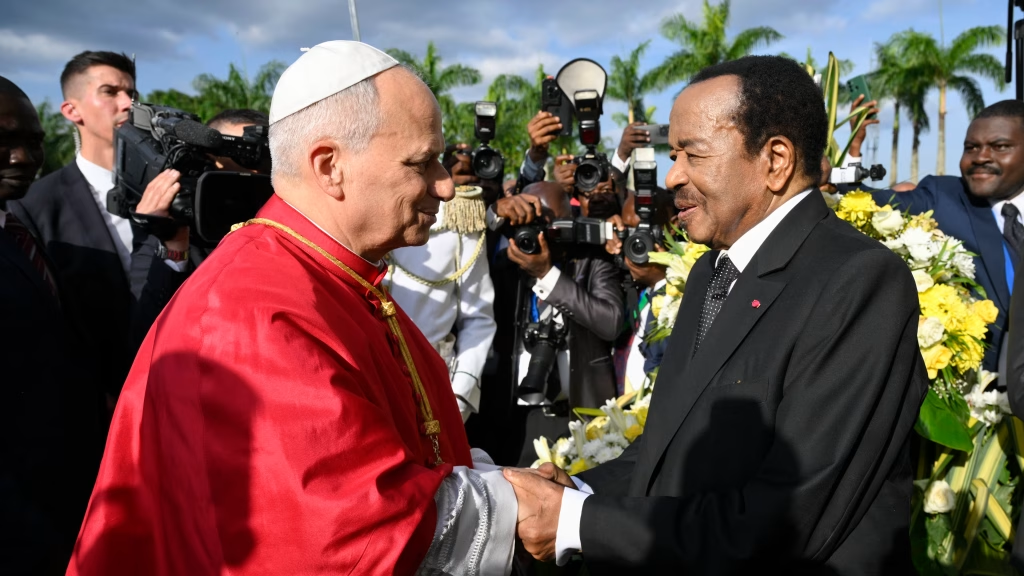
The Road to Bamenda: Can Pope Leo XIV Healing 9 Years of Conflict in Cameroon?
BAMENDA – The scars of a nine-year insurgency in Cameroon’s Anglophone regions are written in numbers that haunt the conscience of the international community. As Pope Leo XIV arrives in Bamenda this April 16, he steps into a landscape defined by tragedy: over 7,000 lives lost, one million people displaced from their homes, and more than 600,000 students robbed of their education at the peak of the crisis, according to data documented by the International Crisis Group (ICG), these figures represent more than just statistics; they are the backdrop of a conflict that has pitted brothers against each other…”
These figures represent more than just statistics; they are the backdrop of a conflict that has pitted brothers against each other, seeking separation between the country’s two Anglophone and eight Francophone regions.
From Desolation to Light: The Bafut Airport Milestone
Nowhere is the symbol of this visit more visible than at the Bafut Airport. Long abandoned and reclaimed by silence during the years of fighting, the airport has “seen the light” once again. In a race against time, authorities accelerated maintenance work to transform this desolate site into a sanctuary of peace. Today, it stands ready to host a historic mass, serving as a powerful metaphor for the reconstruction—both physical and social—that the Vatican hope to inspire in Cameroon.
The Algiers Momentum Meets the Bamenda Ceasefire
The momentum for this visit began in Algeria, where the Pope’s message of interfaith harmony set a high diplomatic bar. That The Algiers Momentum appears to have traveled south; in a rare breakthrough, several secessionist factions have declared a unilateral ceasefire for the duration of the Pontiff’s stay. For a region that has known little but uncertainty, this pause in hostilities offers a rare window of hope, analysts at the International Crisis Group (ICG) suggest that this Papal visit provides the President with a unique ‘exit strategy’…”
A Turning Point for the Presidency
The visit comes at a moment of deep political transition in Yaoundé. At 93, President Paul Biya—the world’s oldest sitting leader—is beginning to shape the era after his departure. With the recent constitutional amendment creating the post of Vice President, analysts from the International Crisis Group (ICG) suggest that this Papal visit provides the President with a unique “exit strategy” to signal a major shift in his Anglophone policy.
By engaging with the Vatican’s quiet diplomacy, which has been championed by faith leaders since 2016, the government has an unprecedented opportunity to extend a formal invitation for negotiated peace talks.

Related posts
Bendjama rejects attempts to bypass Sahrawi Self-determination at UN
Didouche Mourad..The youngest of the six historic leaders of Algeria’s revolution
Algeria’s upper house unanimously approves army deployment to Niger
Tebboune: Algeria Respected for Independent Foreign Policy and Regional Peace Role
Bendouda Calls for Cultural Sovereignty at Saint Petersburg Forum
Attaf, Boulos discuss Algeria-US relations and regional issues
Air algérie launches direct Algiers-Berlin route